Great Southern Ruins Conflict Zone
Systema Delenda EstGreat Southern Ruins Conflict Zone is a System-defined battlefield on Sydea, occupying rolling hills where the savannah gives way to rising ground. Its decisive importance lies in the collision between an apparently ancient or abandoned city and the System’s active mechanisms: the ruins are populated by engineered abominations, quests can expose movement through the Zone, and a high-ranking local arrives when Cato’s reconnaissance briefly reveals his presence. The location is therefore both archaeological mystery and tactical trap, a place where history, resource extraction, and System control become inseparable.
Setting and Ruined Architecture
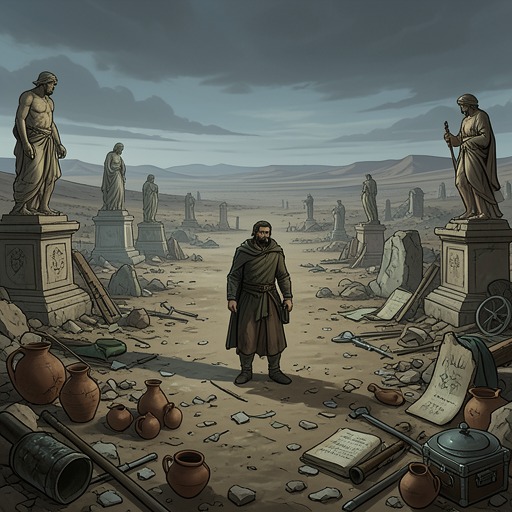
Great Southern Ruins Conflict Zone is set in a pocket of rolling hills at the boundary between flat savannah and sloped terrain. Overgrown structures loom from the hills, giving the Zone its name and suggesting the remnants of a once-industrial city. Cato cannot establish whether the city was built by an earlier Sydean civilization or generated fully formed by the System; Earth’s integration leads him to suspect that the System more often reuses existing landmarks than creates every structure from nothing.
The city’s architecture preserves a recognizable but uncertain technological history. Its buildings consist of broad, swooping domes raised on large stone pylons, lifting them above a floodplain that no longer exists. Damage to the pylons reveals iron-reinforced concrete, a material combination that suggests substantial engineering without proving the presence of a heavily industrialized society. Rusted streaks may be the remains of flagpoles, electrical connections, or something else entirely. The ruins resist definitive interpretation because the devastation has erased the ordinary evidence by which a civilization would be identified.
That uncertainty is intensified by the absence of ordinary environmental logic. Cato later skirts the Zone toward the hills and notices caves in terrain with no nearby water or volcanic features, yet the System has placed them there as part of a Low Hills Resource Zone apparently designed for ore gathering. The surrounding geography thus operates less like a naturally evolved landscape than a managed game environment, with zones, resources, dungeons, and conflict sites arranged according to System purposes.
Monsters and the System’s Distortion of Place
The Zone’s inhabitants distinguish it from the Southern Jungle Conflict Zone and the open savannah. The jungle contains ordinary beasts enlarged to heroic proportions, while the savannah supports herds of animals suitable for meat. The ruins instead crawl with unmistakable System abominations: vaguely humanoid, scaled like Sydea’s native peoples, but possessing flat, eyeless faces split by huge tooth-filled jaws.
Their bodies are legless below the torso. They move by climbing and clambering with massively oversized arms, hauling themselves over and around the domes rather than walking through the city. Smaller specimens remain associated with individual buildings, turning each structure into a relatively discrete encounter. Their elite counterparts are identical in form but immense in scale. Some are tall enough for their heads to reach the domes, and they hand-walk or drag themselves through the gaps between the buildings.
The largest creatures follow a regular patrol route, emerging from and disappearing into a huge central dome. Cato’s flying reconnaissance makes this pattern visible from above, transforming what might otherwise appear to be random monster activity into an organized spatial system. The central dome functions as both landmark and lair, while the smaller structures create separate pockets of danger. The architecture is consequently not merely a backdrop for combat; it dictates how the Zone’s population moves and how an intruder must approach it.
Cato judges that the monsters are within a narrow margin of resemblance to the Sydean people and may be the same species twisted by System processes into grotesque mockeries. He cannot determine whether they retain intelligence, or whether they are degenerate descendants or distorted reproductions of the city’s original inhabitants. His uncertainty gives the ruins a moral dimension: destroying the city from orbit might eliminate a threat, but removing the System might conceivably restore its inhabitants to a more normal state, creating a different logistical and ethical catastrophe.
Cato’s Incursion and the Quest Trap
The Zone becomes strategically important during Cato’s counter-invasion of Sydea. After the System begins recovering from disruption, it issues the Global Defense Quest: Destroy the Incursion, with a recommended rank of High Gold and a B-Tier Skill reward. The quest names multiple locations, including southeastern and northeastern Coren, Mosaw City, Korel Town, and Mosul Town. This wide distribution reflects the spread of Cato’s flying scouts, but it also signals that the System is converting his invasion into a networked defense operation.
Cato does not remain in the ruins once the quest update appears. Because the Zone is small, he considers it a poor place to be trapped, and he diverts toward the farther hills. The border terrain cannot be avoided, so he plans to cross it quickly, while the caves offer a possible opportunity to replenish his metal stocks. The Zone’s danger therefore combines military pursuit with material scarcity: Cato is not only evading defenders but also maintaining a warframe whose unconventional organic machinery depends on recoverable resources.
The System’s recovery produces the decisive reversal. Once the quest display settles and dozens of Zones appear, an enormous bloom of fire erupts above the ruins. A local elite bursts from it into the air, revealing flame-colored scales and fine red chain over dark orange leather. Cato infers that one of his fliers briefly clipped the Zone’s boundary. Because the fliers cannot directly perceive the quest updates, that momentary intrusion was enough to suggest that either someone had completed the local defense quest or the target had passed through the small Zone.
The resulting encounter demonstrates how the System turns geography into surveillance. Cato’s machines do not need to be destroyed or openly detected for the Zone to become dangerous; a boundary violation can be translated into a quest inference, and the inference can summon a high-ranker. The conflict site is therefore an information trap as much as a physical battlefield.
Escape into the Underground
When the elite surveys the air above the ruins, Cato chooses concealment rather than an exposed fight. His threat processes push him into framejack, although the acceleration is almost unnecessary because the danger is already obvious. He rejects remaining still and trusting his camouflage, as well as attempting to outrun the elite’s perceptions, and instead bolts for the nearest cave entrance.
The entrance is only wide enough for two warframes, forcing Cato into a passage network that may lead toward one of the great underground zones. Acoustic mapping reveals a labyrinth, but accelerated cognition gives him time to study its structure and plot a route before the entrance disappears from sight. He must account for passages too narrow for his body, since a wrong turn could leave the enormous warframe physically trapped.
His flight carries him over a low-rank party hauling sleds of mined ore. The wind of his passage whips at their cloaks as he leaps above them, after which he bounds from wall to wall and descends farther underground. The moment emphasizes the contrast between Cato’s strategic emergency and the routine economy of the Zone: while a high-ranker searches overhead, ordinary delvers continue extracting resources from the System’s artificial landscape.
The cave itself confirms Cato’s suspicion that the terrain is manufactured rather than natural. Grey-white granite is flecked with minerals, and glowing crystals embedded in the walls provide illumination. The passages lack the tiny dead-end threads, slippery mud, uneven footing, collapses, and required bracing that characterize real caves. Most are comfortably high and wide, with no toolmarks to explain their regularity. To resource gatherers the arrangement may be convenient, but to Cato—who has specialized in exogeology—it is an affront to geological reality and another expression of System design.
Narrative Significance
Great Southern Ruins Conflict Zone concentrates the book’s opposition between Cato’s industrial rationalism and the System’s imposed physics. Cato’s warframe is itself an organic workaround to the System’s prohibition on advanced technology: its cells fuse deuterium and its organs function more like industrial machinery than natural biology. The Zone mirrors that compromise in environmental form. Concrete, metal, caves, monsters, quests, and resource nodes all resemble recognizable components of a world, yet their arrangement has been bent toward System gameplay and control.
The location also makes environmental damage visible without reducing it to a single explosion. A former floodplain has vanished, a city has become overgrown and ruined, and its possible inhabitants have been transformed into predatory bodies. The uncertainty over whether those creatures are surviving natives, descendants, or reproductions prevents the ruins from becoming a simple monster nest. Their existence embodies a slower, more difficult question: whether liberation from the System would restore what the System has distorted, or merely expose further layers of irreversible damage.
Finally, the Zone dramatizes the limits of Cato’s counter-invasion. His scouts provide extraordinary reach, but their imperfect relationship with System boundaries creates the very clue that summons his pursuer. His technological advantage is powerful enough to spread across multiple regions, yet it remains forced to operate inside a hostile infrastructure of quests, ranks, zones, and imposed physics. Great Southern Ruins Conflict Zone is consequently a small battlefield with system-wide implications: a place where the landscape remembers an uncertain past, the System weaponizes the present, and Cato’s escape depends on entering an artificial underworld rather than mastering the surface.